

Activities with excessive total float
Activities with excessive total float
Introduction

In Primavera P6, total float represents the amount of time an activity can be delayed without affecting a key schedule date, such as the project finish, a contractual milestone, or a relevant constraint. A certain amount of float is normal and desirable, as it allows the schedule to absorb variations, uncertainty, and execution adjustments.
However, when an activity has excessively high total float, it may indicate that it is not properly integrated into the schedule logic. In those cases, the activity may be weakly linked, isolated from the main work sequence, or connected in a way that does not properly reflect the execution strategy.
xerPlanner’s analysis identifies activities whose total float exceeds a threshold defined based on the project’s total duration. In this case, float is considered excessive when it exceeds 10% of that duration, measured in calendar days from the project start to the project finish.
Why excessive float can be a problem
Excessive float can create a false sense of flexibility. An activity with many days of float may appear to be irrelevant to the project finish date, but it may actually be poorly connected or not properly representing its dependencies with other activities.
The following screenshot shows an example of activities with excessive total float in Primavera P6. Although these activities are not necessarily causing a delay, their high float values indicate that they should be reviewed to confirm whether they are properly integrated into the schedule logic network.
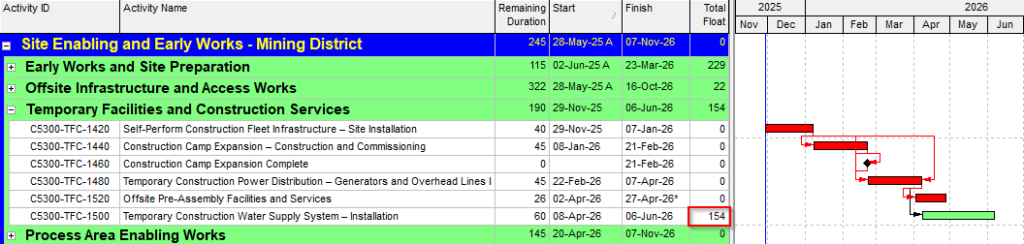
This condition can create several issues:
- activities weakly connected to the main project flow;
- incomplete or unrepresentative logic;
- difficulty identifying the true critical path;
- lower schedule sensitivity to real changes;
- underestimation of the impact of certain activities;
- loss of traceability between the plan and the actual execution strategy.
In large projects, excessive float can go unnoticed. The schedule may look reasonable at a high level, especially in cumulative charts or summarized views, while still containing activities with weak logical integration. This is why these cases should be reviewed individually.
Cases that require careful interpretation
High float is not always incorrect. Some activities may naturally have more margin than others, especially if they correspond to secondary work, administrative tasks, non-critical deliverables, or activities that can be performed within a broad execution window.
There may also be activities with high float due to contractual decisions, external constraints, or deliberate execution strategies. In those cases, the finding does not necessarily require immediate correction, but there should be a clear justification.
The risk appears when excessive float is not intentional. If an activity has hundreds of days of float without an evident reason, it may indicate a missing logical relationship, a partially connected activity, or a dependency that is not properly represented in the schedule.
Best practices
The first step should be to review the logic relationships of activities with excessive float. It is important to verify whether they have enough predecessors and successors, whether the relationship types are appropriate, and whether the activity is connected to the milestones or deliverables it actually controls or depends on.
It is also important to review whether constraints, calendars, or sequences are artificially generating high float values. In some cases, the solution may be to add missing relationships; in others, to correct existing links, adjust constraints, or review the execution strategy represented in the schedule.
The goal is not to eliminate all float. A schedule with no margin can be as problematic as a schedule with excessive float. The objective is to ensure that the available float is logical, explainable, and consistent with the project reality.
Conclusion
Activities with excessive total float do not necessarily represent an error, but they are an important review signal. Excessively high float may indicate that the activity is weakly integrated, that logical relationships are missing, or that the schedule is not properly reflecting the execution strategy.
Reviewing these findings helps improve the quality of the logic network, strengthen schedule credibility, and prevent relevant activities from being artificially isolated from the main project flow. Float should exist, but it should be reasonable, traceable, and technically justifiable.