

Finish to Start links with positive lags
Finish to Start links with positive lags
Introduction

In Primavera P6, the Finish to Start relationship is one of the most commonly used dependencies to represent the logical sequence between activities. In this type of relationship, the successor activity can only start after the predecessor activity has finished.
When a positive lag is added to a Finish to Start relationship, a time interval is introduced between the predecessor’s finish and the successor’s start. In some cases, this interval may represent a real and justified waiting period. However, it may also hide work, constraints, or conditions that should be explicitly represented in the schedule.
xerPlanner identifies Finish to Start relationships with positive lags so the planner can review whether those lags are properly justified or whether they should be replaced with explicit activities.
Why positive lags in FS relationships can be a problem
A positive lag in a Finish to Start relationship creates a waiting period between two activities. For example, one activity finishes, but the next one cannot start until several days later. If that waiting period represents a real condition, such as curing, drying, area release, inspection, approval, or mobilization, it may be reasonable.
The problem appears when the lag is used to replace work that should be modeled as an activity. In that case, the schedule loses visibility, because there is time within the sequence that has no owner, explicit duration, resources, progress, or traceability.
The following screenshot shows an example of a Finish to Start relationship with a positive lag in Primavera P6. Although the relationship may look correct visually, the lag should be reviewed to confirm whether it represents a justified waiting period or an omitted activity.
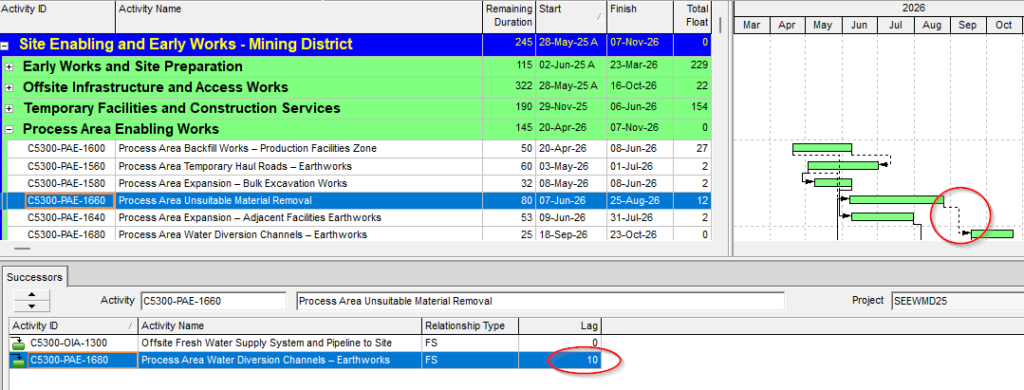
This type of lag can create several issues:
- hide intermediate activities that should be planned;
- reduce the traceability of the logic sequence;
- make actual progress harder to track;
- prevent clear assignment of resources or responsibilities;
- distort the interpretation of the critical path;
- raise concerns during quality reviews, audits, or schedule analysis.
The key point is that a lag is not updated or controlled like an activity. If it represents real work, it should be measurable, reportable, and manageable.
When an FS lag may be justified
Not every positive lag in a Finish to Start relationship is incorrect. There are cases where the lag represents a real technical waiting period rather than executable work. Examples include curing time, setting time, drying time, regulatory waiting periods, access windows, or minimum intervals between two events.
Even so, these cases should be carefully reviewed. If the waiting period requires tracking, resources, inspections, ownership, or partial progress, it is probably better to model it as a separate activity.
As a general criterion, the more relevant the interval is for project control, the more appropriate it is to represent it explicitly in the schedule instead of hiding it inside a lag.
External relationships marked with [e]
In this analysis, xerPlanner may mark findings with [e] when they are associated with external relationships, meaning relationships between activities that belong to different projects within the XER file.
This mark is important because the finding depends on the existence of that relationship. If the XER file is imported into a database where the related external project does not exist, the relationship may disappear, and the lag causing the finding may disappear with it. On the other hand, if the schedule is imported or reviewed in a database where the external project does exist, the relationship remains and the finding is still valid.
For this reason, the [e] mark does not mean that the finding is less important. It indicates that its persistence depends on whether the external relationship exists in the database where the schedule is reviewed or imported.
Best practices
The best practice is to review each Finish to Start relationship with a positive lag and confirm what the lag actually represents. If it corresponds to a simple and justified technical waiting period, it may remain, ideally with a clear explanation in the schedule methodology or review comments.
If the lag represents work, management effort, inspection, transfer, approval, release, or any condition that should be controlled, it is recommended to replace it with an explicit activity. This allows the schedule to assign ownership, duration, resources, calendar, progress, and its own logical relationships.
It is also advisable to avoid using lags extensively as a mechanism to adjust dates. A good-quality schedule should explain the execution sequence through clear activities and logical relationships, not through lags that hide part of the work flow.
Conclusion
Finish to Start relationships with positive lags are not necessarily incorrect, but they should be carefully reviewed. A lag may represent a valid technical waiting period, but it may also hide intermediate activities, reduce schedule traceability, and make project control more difficult.
Reviewing these relationships helps improve the clarity of the logic network and confirms whether the work sequence is properly represented. When the lag corresponds to real work or to a condition that must be managed, replacing it with an explicit activity usually results in a more transparent, controllable, and reliable schedule.