

Activities with negative total float
Activities with negative total float
Introduction

In Primavera P6, total float indicates how much an activity can be delayed without affecting a key schedule date, such as the project finish, a contractual milestone, or an imposed constraint. When an activity has negative total float, it means the schedule no longer has enough margin to meet one of those dates under the current conditions.
xerPlanner identifies activities whose total float is less than zero. This condition indicates that, based on the current schedule logic, remaining durations, relationships, calendars, and applied constraints, there is time pressure that prevents the schedule from meeting a target date.
Negative float should not automatically be interpreted as a scheduling error, but it is a critical warning sign that requires review. It may be caused by actual delays, incorrectly configured constraints, demanding contractual commitments, unrealistic logic, or a combination of several factors.
Why negative total float is a problem
An activity with negative total float indicates that the schedule needs to recover time in order to meet the date controlling the calculation. In practical terms, the current plan is not sufficient to achieve the defined time objective.
The following screenshot shows an example of activities with negative total float in Primavera P6. This type of condition helps quickly identify which activities are under time pressure and how much time would need to be recovered to remove the deviation.
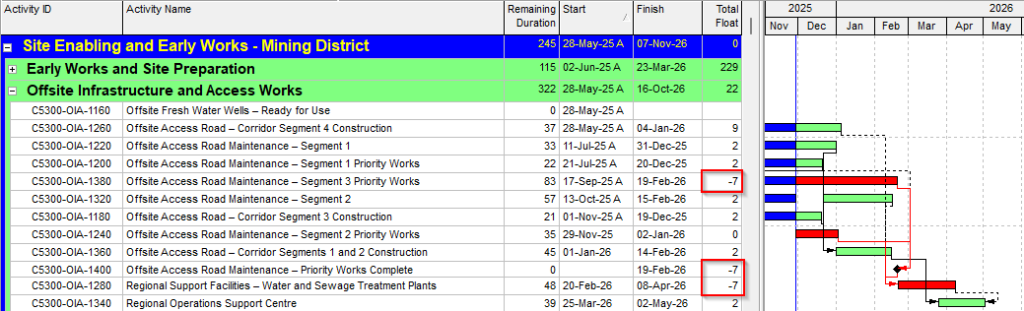
his situation can create several problems:
- loss of schedule credibility;
- difficulty meeting contractual milestones;
- artificial pressure on critical or near-critical activities;
- need to resequence, accelerate, or replan work;
- increased risk of claims, cost overruns, or missed commitments;
- confusion about the real feasibility of the current plan.
Negative float is especially relevant because it does not simply show that an activity has limited margin. It shows that the margin has already been exceeded. In other words, the schedule requires corrective action to become compatible again with its target dates.
Cases that require careful interpretation
Negative float can have different causes, and not all of them mean the same thing. In some cases, it reflects an actual project delay against a contractual date. In others, it may be caused by an overly rigid constraint, an artificially imposed date, or logic that does not correctly represent the execution strategy.
It may also appear when the schedule contains multiple constraints, different calendars, mandatory milestones, or deadlines that put pressure on different parts of the logic network. For this reason, before correcting negative float, it is important to understand which date is generating the pressure and whether that date represents a real project commitment.
Removing negative float without understanding its cause may hide the problem instead of solving it. For example, deleting a contractual constraint just to remove negative float may make the schedule look better, but it does not change the project’s actual obligation.
Best practices
The first step should be to identify what is generating the negative float. It may be a constraint, a contractual milestone, a committed finish date, an extended logic sequence, accumulated delays, or a combination of these elements.
Then, the schedule should be reviewed to confirm whether it accurately represents the project reality. If the logic is incorrect, it should be corrected. If remaining durations are unrealistic, they should be updated. If unnecessary constraints exist, they should be removed or replaced with a better modeling approach. If the target date is contractual and cannot be changed, a real recovery strategy should be evaluated.
Corrective actions may include resequencing activities, increasing resources, splitting work, modifying calendars, adding shifts, reviewing constraints, or renegotiating dates when appropriate. The key is that the solution must be technically feasible, not just a superficial edit to make the indicator disappear.
Conclusion
Activities with negative total float indicate that the schedule does not have enough margin to meet a target date under its current conditions. This affects the credibility and feasibility of the plan, especially when contractual milestones or relevant project commitments are involved.
Reviewing these activities helps identify where time pressure is concentrated, how large the deviation is, and what corrective actions may be required. A schedule with negative float should not be cosmetically adjusted; it should be analyzed, justified, or corrected so it realistically represents the project situation.