

Out-of-sequence update
Out-of-sequence update
Introduction

An updated schedule should reflect not only how much progress has been achieved, but also whether the work was executed according to the planned logic. When an activity progresses in the field before the logical condition defined by its predecessor has been met, an out-of-sequence condition may occur.
In xerPlanner, this analysis identifies relationships where the progress status of the successor activity is not consistent with the progress status of its predecessor, considering the relationship type defined between them. In other words, the analysis does not only check whether a logic relationship exists, but whether the recorded progress respects the condition represented by that relationship.
The analysis considers different cases depending on the relationship type:
- In a Finish to Start (FS) relationship, the successor should not start before the predecessor is complete.
- In a Start to Start (SS) relationship, the successor should not start before the predecessor has started.
- In a Finish to Finish (FF) relationship, the successor should not finish before the predecessor is complete.
- In a Start to Finish (SF) relationship, the successor should not finish before the predecessor has started.
This type of finding usually appears during schedule updating, when the recorded actual progress does not match the planned logic sequence. The situation may be caused by a different execution sequence in the field, poorly modeled logic, a valid construction change not incorporated into the schedule, or a deviation from the plan.
The impact of activities out of sequence
Activities out of sequence may affect schedule reliability because they show a difference between the planned logic and the way the work is actually being executed or recorded.
This does not automatically mean that the field execution was wrong. In some cases, it may represent a construction improvement, an optimization opportunity, or a real sequence that is more efficient than the one originally planned. However, it may also indicate that the schedule was not updated correctly, that the original logic was weak, or that a deviation occurred from a contractual, technical, or strategic sequence.
The problem is that, if these differences are not reviewed, the schedule may begin to lose value as a control tool. The logic network no longer faithfully represents the relationship between the plan and actual execution, which may affect critical path analysis, float interpretation, date forecasts, and impact evaluation.
For example, if a successor activity has already started while its Finish to Start predecessor is not yet complete, the schedule is showing that the work progressed before the originally defined logical condition was met. This may be justified, but it requires reviewing whether the relationship should be kept, modified, removed, or documented as an accepted deviation.
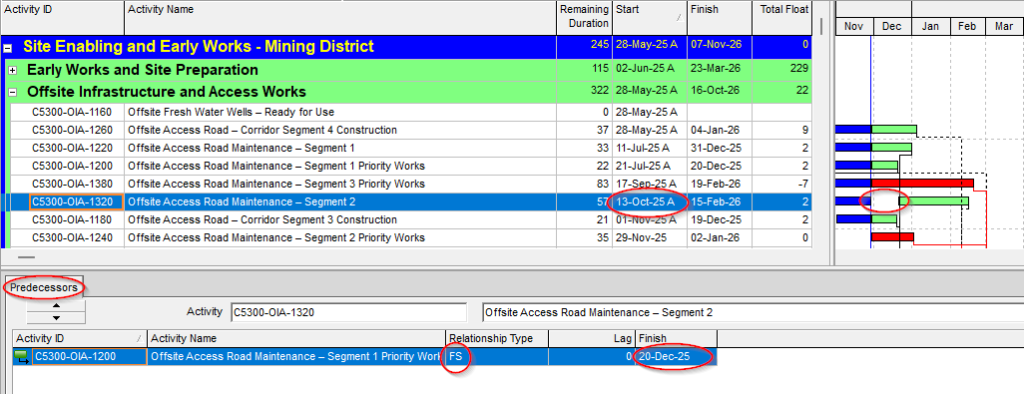
The following image shows an example of an out-of-sequence relationship, where the recorded progress does not fully respect the logic defined between predecessor and successor. This type of situation should be reviewed to confirm whether the schedule logic still correctly represents project execution.
Cases that should be interpreted carefully
The fact that xerPlanner reports an activity out of sequence does not automatically mean that there is an error. The finding indicates that the relationship between the predecessor progress status, the successor progress status, and the defined relationship type should be reviewed.
In some cases, actual execution may have changed for a valid reason. For example, the field team may have started an activity earlier than planned because real conditions allowed it, even though the original schedule did not reflect that possibility. In other cases, the update may reveal that the logic relationship was poorly defined from the beginning.
It may also happen that the real sequence is acceptable from a construction perspective, but not from a contractual or control perspective. Therefore, the review should not be limited to asking whether the work could be executed, but also whether that execution respects the plan directives, contractual commitments, and project control strategy.
This analysis may also identify out-of-sequence relationships involving external activities. In those cases, xerPlanner marks the finding with “[e]”. For this analysis, that mark has a particular interpretation: it indicates that the out-of-sequence condition depends on a relationship with an external activity. If the XER file is imported into a database where the external project does not exist, that relationship may not be available and, therefore, the finding may no longer apply.
This is different from other logic analyses, where the absence of an external relationship may confirm a problem. In activities out of sequence, the external relationship is precisely what generates the finding.
It is also important to consider the analysis scope selected by the user. If all activities are reviewed, xerPlanner may detect more cases, including relationships where the successor activity has already been completed. If only remaining activities are reviewed, the analysis may return fewer findings, especially for relationships where the out-of-sequence condition becomes evident when the successor activity is already complete.
Best practices for managing activity out of sequence
To properly manage this type of finding, the first step is to review the specific relationship between the predecessor and successor activity. It is not enough to observe that both activities exist or that they have progress; it is necessary to confirm whether the recorded progress is consistent with the defined relationship type.
In practical terms, the review should consider at least the following:
- Identify the logic relationship type involved: FS, SS, FF, or SF.
- Review the progress status of the predecessor activity.
- Review the progress status of the successor activity.
- Confirm whether the actual execution occurred in a different order than planned.
- Evaluate whether the real sequence represents an improvement, a deviation, or an update error.
- Review whether the original logic relationship is still valid.
- Adjust the schedule logic if the actual execution sequence has changed.
- Document the justification when the out-of-sequence execution is accepted.
- Review findings marked with “[e]” considering that they depend on external relationships.
- Consider the selected analysis scope: all activities or only remaining activities.
When actual execution does not match the planned logic, the schedule should be updated so that it continues to reasonably represent the project reality. Keeping out-of-sequence relationships without review may weaken the reliability of forecasts and make future impact analysis more difficult.
Conclusion
Activities out of sequence show a difference between the planned logic and the progress recorded in the schedule. This difference does not always represent an error, but it should always be reviewed because it may reveal execution deviations, improvement opportunities, logic issues, or weaknesses in the update process.
In xerPlanner, this analysis identifies relationships where the successor progress status is not consistent with the predecessor progress status, considering the defined relationship type. It also distinguishes cases associated with external relationships using the “[e]” mark, whose interpretation in this analysis is particular: if the external relationship does not exist in another database, the finding may no longer apply.
Reviewing and correcting these situations helps the schedule better reflect actual project execution, maintain reliable logic, and remain useful for critical path analysis, float interpretation, impact assessment, and control decisions.