

Negative Lags (Leads) in Activity Relationships
Negative Lags (Leads) in Activity Relationships
Introduction

In Primavera P6, activity relationships represent the logical sequence of work. These relationships define how one activity depends on another and support the calculation of dates, critical path, float, and the overall schedule flow.
A negative lag, commonly known as a lead, occurs when a value below zero is applied to a logic relationship. In practice, this allows a successor activity to occur earlier than the condition that should be satisfied by its predecessor.
xerPlanner identifies relationships between activities that have negative lags, regardless of the relationship type. These cases should be reviewed with particular attention, because leads usually introduce ambiguity, weaken schedule logic, and complicate both schedule interpretation and more advanced analyses.
Why leads are a problem
A lead artificially modifies the relationship between two activities. In a Finish to Start relationship, for example, a lead allows the successor activity to start before the predecessor has finished. This may look like a quick way to represent overlap, but it can hide logic that should be modeled more clearly.
In other relationship types, the problem may be even more evident. In a Start to Start relationship with a negative lag, the successor could start before its predecessor. This contradicts the natural logic of the relationship and can create a sequence that is difficult to justify.
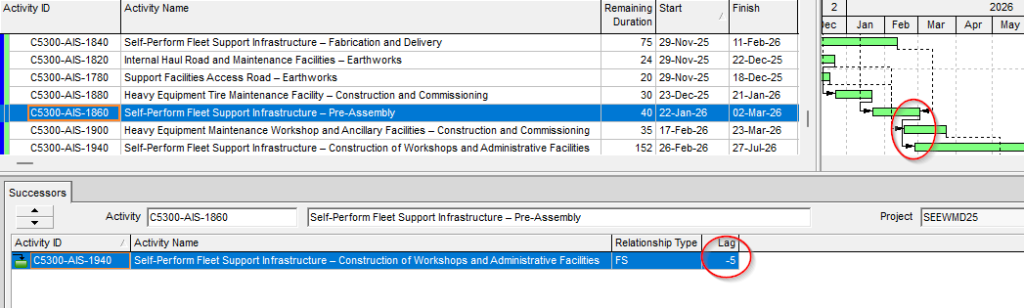
The following screenshot shows an example of a relationship with a negative lag in Primavera P6. Even if the value appears small, the issue is not only the number of days, but the fact that the relationship is forcing a logical anticipation.
Leads can create several problems:
- they weaken the clarity of the logic network;
- they make the actual execution sequence harder to interpret;
- they hide overlaps that should be modeled with clearer activities or relationships;
- they may distort the critical path and float values;
- they make third-party schedule reviews more difficult;
- they create additional challenges in risk analysis, audits, or forensic schedule analysis.
In practical terms, a lead is often a sign that the selected relationship does not properly represent the real work sequence.
It is better to change the logic than to use a lead
In most cases, if an overlap between activities needs to be represented, it is better to change the relationship type or break down the work into clearer activities instead of using a negative lag.
For example, if an activity can start before its predecessor is fully complete, it may be better to evaluate whether a Start to Start relationship with a positive lag is more appropriate, whether the predecessor should be split into more specific activities, or whether intermediate activities should be added to better explain the real work flow.
The objective is not simply to remove the negative number, but to represent the execution logic in a clearer and more controllable way. A good-quality schedule should make it possible to understand why an activity can start, continue, or finish on a given date without relying on hidden anticipations inside relationships.
Impact on risk analysis and simulations
Leads can also complicate risk analysis based on simulations, such as Monte Carlo models. These models depend on a clear logic network to evaluate how duration uncertainty may affect project dates.
When negative lags exist, the mathematical interpretation of the sequence becomes less transparent. Relationships no longer represent a direct dependency and begin to introduce anticipations that may be difficult to explain in the results. This does not mean that a simulation is impossible, but it does mean that the results may become harder to review, communicate, and defend technically.
For this reason, if the schedule will be used for risk analysis, leads should be removed or very carefully justified before running the model.
External relationships marked with [e]
xerPlanner may mark findings with [e] when they are associated with external relationships, meaning relationships between activities that belong to different projects within the XER file.
This mark indicates that the finding depends on the existence of that external relationship. If the XER file is imported into a database where the related external project does not exist, the relationship may disappear and, therefore, the lead causing the finding may also disappear. On the other hand, if the schedule is reviewed or imported into a database where the external project does exist, the relationship remains and the finding is still valid.
The [e] mark does not mean that the lead is acceptable. It only warns that the finding depends on an external relationship that may not be preserved in another Primavera P6 environment.
Best practices
The best practice is to avoid using leads in schedule relationships. If a relationship requires a negative lag to represent the sequence correctly, the logic should probably be reviewed.
Before correcting the finding, it is important to understand what the planner intended to represent. If the lead was used to model a real overlap, a more appropriate relationship type, a more detailed activity breakdown, or an alternative sequence should be evaluated to explain the work flow more clearly.
Leads should only remain in exceptional cases, with a clear and documented technical justification. In contractual schedules, audited schedules, forensic analyses, or risk models, their use should be avoided even more strongly.
Conclusion
Negative lags or leads are a critical condition within schedule logic. Although they may seem like a quick solution to represent overlaps, they usually create ambiguity, weaken traceability, and complicate the interpretation of the logic network.
Reviewing and correcting these relationships helps build a clearer, more defensible, and technically stronger schedule. Instead of forcing anticipations through negative lags, it is better to represent the real work sequence through activities, relationships, and well-justified positive lags.