

Links between activities with excessively long positive lags
Links between activities with excessively long positive lags
Introduction

In Primavera P6, positive lags allow a time interval to be introduced between two related activities. In certain cases, they may represent legitimate planned waiting periods, such as curing, drying, approval, area release, mobilization, or any other period that must pass before the successor activity can proceed according to the defined relationship.
However, when a positive lag is too long compared with the duration of the predecessor activity, it may indicate that the schedule is hiding work or conditions that should be explicitly represented as activities. This weakens the traceability of the logic network and reduces schedule transparency.
xerPlanner identifies relationships between activities with positive lags whose duration is considered excessive. The purpose is to flag cases where the lag may be replacing intermediate activities, controllable waiting periods, or scheduling decisions that should be reviewed in more detail.
When a lag is considered excessive
In this analysis, xerPlanner considers a positive lag excessive when it exceeds 10% of the predecessor activity duration.
For example, if a predecessor activity lasts 20 days, a 1-day lag is probably not structurally relevant. However, if the predecessor lasts 3 days, that same 1-day lag represents a much more significant proportion of the logic sequence and should be reviewed.
For milestones, since they have no duration of their own, xerPlanner uses a different criterion: the lag is considered excessive when it exceeds a threshold equivalent to 10% of the total project duration, measured in calendar days from project start to project finish. This rule provides an objective criterion for relationships where the predecessor activity has no duration.
This relative approach may seem strict when looking at small absolute values, but its purpose is to detect lags that are disproportionate to the logic they affect. A lag should not be evaluated only by the number of days it contains, but also by its relative size within the sequence it modifies.
Why excessive lags can be a problem
An excessive lag can hide important parts of the work flow. If the period represented by the lag requires management, resources, ownership, inspections, tracking, or validation, it should probably be modeled as a separate activity.
The following screenshot shows an example of relationships with positive lags in Primavera P6. Although these lags may look like simple sequence adjustments, when their duration is high relative to the predecessor activity, they can affect the logical quality of the schedule.
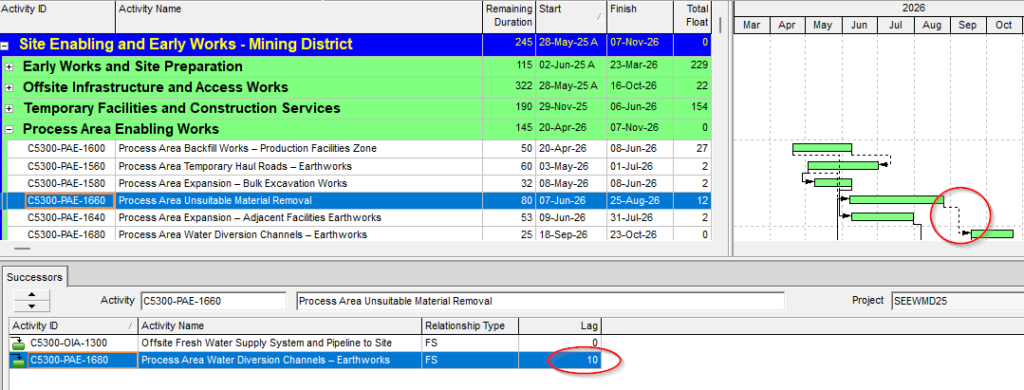
This condition can create several issues:
- hide intermediate activities that should be planned;
- make actual progress harder to track;
- reduce traceability between related activities;
- prevent clear assignment of resources or responsibilities;
- distort the interpretation of the critical path;
- weaken schedule transparency during reviews, audits, or planning analysis.
The issue is not the use of lags itself, but the use of excessive lags as a substitute for clearer and more controllable logic.
Cases that require careful interpretation
Not every excessive lag automatically represents an error. There may be cases where the lag reflects a legitimate technical waiting period or a real external condition. For example, certain curing processes, regulatory approvals, access restrictions, or operational windows may justify a significant interval between two activities.
Even so, the longer the lag, the more important it is to review whether it should remain as a lag or be transformed into an explicit activity. If the period has an owner, controllable duration, risk, resources, or progress potential, it is usually better to represent it in the schedule as its own activity.
It is also important to consider that the relative threshold may detect cases that appear small in absolute days. This is intentional. A short lag may still be relevant if it affects a very short activity, because it significantly changes the logical proportion between predecessor and successor.
External relationships marked with [e]
xerPlanner may mark findings with [e] when they are associated with external relationships, meaning relationships between activities that belong to different projects within the XER file.
This mark indicates that the finding depends on the existence of that external relationship. If the XER file is imported into a database where the related external project does not exist, the relationship may disappear and, therefore, the lag that caused the finding may also disappear. On the other hand, if the schedule is reviewed or imported into a database where the external project does exist, the relationship remains and the finding is still valid.
For this reason, the [e] mark should not be interpreted as an automatic correction or as a minor finding. It is a warning that the finding depends on an external relationship.
Best practices
The best practice is to review each excessive positive lag and confirm what it actually represents. If it corresponds to a simple, justified technical waiting period that does not require detailed control, it may remain as a lag.
If the lag represents work, management effort, inspection, approval, transfer, area release, a relevant waiting period, or any condition that should be controlled, it is recommended to replace it with an explicit activity. This improves traceability, allows ownership to be assigned, supports tracking, and makes the schedule logic more transparent.
It is also advisable to avoid using excessive lags to adjust dates artificially. A good-quality schedule should explain the execution sequence through understandable activities and logical relationships, not through hidden intervals that make the plan harder to review.
Conclusion
Excessive positive lags are not necessarily incorrect, but they are a clear review signal. A lag may be justified, but when it is too large compared with the duration of the predecessor activity, it may indicate that the schedule is hiding work, relevant waiting periods, or scheduling decisions that should be explicitly represented.
Reviewing these findings helps validate whether the lags accurately reflect the real project sequence or whether they should be replaced with clearer and more controllable activities. A transparent schedule does not only show when activities occur; it also explains what happens between them.