

Start to Finish Activity Relationships
Start to Finish Activity Relationships
Introduction

In Primavera P6, logic relationships between activities represent the project execution sequence. The most common relationship types are Finish to Start, Start to Start, and Finish to Finish, because they usually reflect more naturally how work is performed in the field.
The Start to Finish relationship is much less common. In this type of relationship, the finish of the successor activity depends on the start of the predecessor activity. This logic is often difficult to interpret, unintuitive, and, in most cases, unnecessary to properly represent the work sequence.
xerPlanner identifies Start to Finish relationships so the planner can review whether they are truly justified or whether they should be replaced with clearer and more defensible relationships.
Why Start to Finish relationships can be a problem
A Start to Finish relationship can create confusion because it reverses the usual way dependencies between activities are interpreted. Instead of indicating that an activity starts or finishes after a previous event occurs, it establishes that an activity cannot finish until another one has started.
The following screenshot shows an example of a Start to Finish relationship in Primavera P6. Although the relationship may be technically valid within the software, its interpretation is not always clear for those who review, update, or audit the schedule.
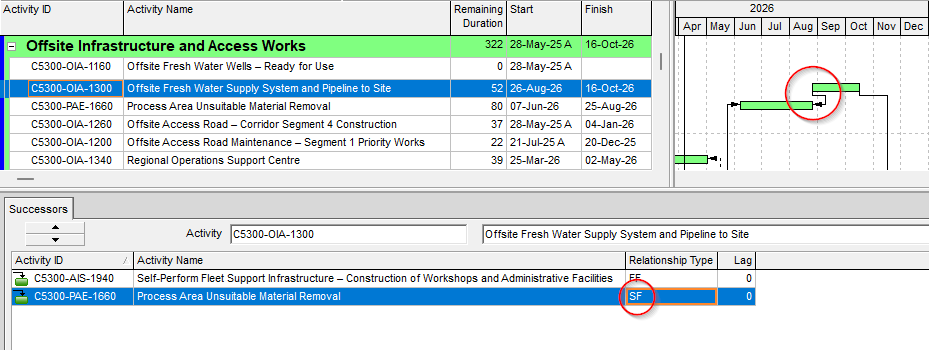
This type of relationship can create several issues:
- it makes the logic sequence harder to read naturally;
- it may distort the interpretation of the critical path;
- it complicates float analysis;
- it reduces schedule transparency for third-party reviewers;
- it makes audits, forensic analysis, or contractual reviews more difficult;
- it may affect the interpretation of risk models or simulations.
In most schedules, a Start to Finish relationship is usually a sign that the logic should be reviewed. It can often be replaced with a clearer combination of activities, milestones, and Finish to Start, Start to Start, or Finish to Finish relationships.
Exceptional case between start and finish milestones
xerPlanner does not report Start to Finish relationships when the predecessor is a start milestone and the successor is a finish milestone. In that specific case, the SF relationship may be the only logical way to directly connect both milestones, so it is not included in this finding.
However, this exclusion does not mean that the relationship is ideal or recommended in every context. In contractual schedules, audits, or claim analyses, even this type of relationship may be difficult to defend if it is not clearly explained.
Therefore, when a Start to Finish relationship is used between start and finish milestones, its purpose should be explicitly documented in the schedule methodology. The relationship may be acceptable as a technical exception, but it should not be used without a clear reason.
External relationships marked with [e]
xerPlanner may mark findings with [e] when they are associated with external relationships, meaning relationships between activities that belong to different projects within the XER file.
This mark indicates that the finding depends on the existence of that external relationship. If the XER file is imported into a database where the related external project does not exist, the relationship may disappear and, therefore, the Start to Finish relationship causing the finding may also disappear. On the other hand, if the schedule is reviewed or imported into a database where the external project does exist, the relationship remains and the finding is still valid.
The [e] mark does not mean that the relationship is acceptable. It only warns that the finding depends on an external relationship that may not be preserved in another Primavera P6 environment.
Best practices
The best practice is to avoid Start to Finish relationships, except in exceptional and clearly documented cases. If the schedule contains relationships of this type, the planner should review what they are intended to represent and whether there is a clearer way to model the same sequence.
In many cases, the solution may be to split activities, add intermediate milestones, or replace the relationship with a more conventional one. The goal is not simply to modify the logic to remove the finding, but to represent the real work sequence in a more understandable and defensible way.
When a Start to Finish relationship is kept, there should be an explicit technical justification. This is especially important in contractual schedules, schedules subject to external review, claim analyses, or risk models.
Conclusion
Start to Finish relationships are uncommon and often make the schedule harder to interpret. Although Primavera P6 allows them, in most cases they should be reviewed to confirm whether they are truly necessary or whether they can be replaced with clearer logic.
Reviewing these relationships helps improve the transparency of the logic network, make the critical path easier to interpret, and strengthen the technical defensibility of the schedule. A Start to Finish relationship should not be kept simply because the software allows it; there should be a clear, documented reason consistent with the project scheduling methodology.