

Activities without successors
Activities without successors
Introduction

A well-structured project schedule should ensure that its activities are integrated into a coherent logic network.
In general terms, an activity without successors is an activity that does not have a following relationship allowing the logical flow of the schedule to continue toward other activities or toward project completion.
In xerPlanner, this analysis identifies activities within the analyzed project that do not have internal successors. This means that an activity may appear as a finding even if it has a relationship with an external activity belonging to another project included in the XER file.
This is a preventive criterion. If the schedule is later imported into a Primavera P6 database where those external projects do not exist, those relationships may not be available, and the activity would effectively remain without successors within the project’s logic network.
When xerPlanner identifies that an activity reported as a finding may be related to external activities, it marks it with “[e]” before the Activity ID. This mark indicates that the case should be reviewed together with the external relationships section of the report, since the finding may depend on the context in which the XER file will be imported or reviewed.
Activities without successors may indicate uncontrolled terminal points within the schedule. If they do not correspond to the formal project finish milestone or to a properly justified case, they may create loss of traceability, affect critical path analysis, and make progress control more difficult.
The impact of activities without successors
When an activity does not have internal successors, an interruption is created in the logical flow of the schedule. This can make it difficult to understand how that activity contributes to the overall progress of the project and which part of the work depends on its completion.
In a well-structured schedule, activities should not remain as isolated elements at the end of a sequence, unless they represent the formal completion of the project. Each activity should logically lead to another activity, to a relevant milestone, or to a subsequent sequence that explains how the planned work continues.
The absence of successors may affect critical path analysis, float interpretation, and the reliability of the schedule as a control tool. An activity without logical continuity may appear complete from the network perspective, even though its output may be required for other phases, deliverables, or subsequent processes.
For example, an activity that should contribute to a contractual milestone, a commissioning phase, or a final delivery may remain without successors because a relationship was omitted. In that case, the schedule does not correctly represent the dependency between the work performed and the expected project outcomes.
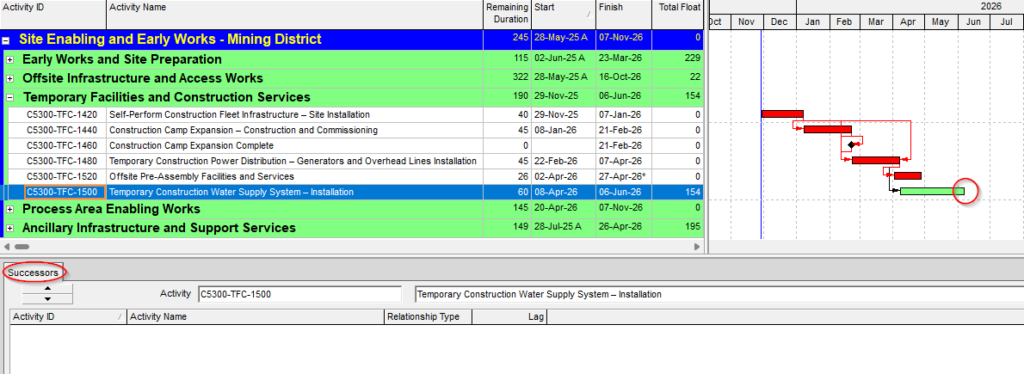
The following image shows an example of an activity that does not continue toward any internal successor within the project. This condition creates a terminal point within the logic network that should be reviewed, especially if it does not correspond to the formal project finish milestone.
Cases that do not necessarily represent an error
Not every activity without successors should be corrected automatically. In many schedules, it is valid to have a single finish milestone without successors, since it represents the logical completion of the project. This final milestone does not require a following activity because its function is to mark the completion of the schedule.
For this reason, xerPlanner excludes the project finish milestone from the analysis when it has been previously identified in the general schedule observations.
WBS Summary activities are also not considered findings in this analysis. This type of activity can work correctly without its own successor relationships, because its start and finish dates are automatically adjusted based on the activities contained within the corresponding WBS.
There may also be activities with external successors. In that case, the finding must be interpreted carefully. If the external project exists in the same database where the schedule will be used, the relationship may remain valid. However, if the XER file is imported into a database where that external project does not exist, the relationship may not be available, and the activity would effectively remain without internal successors.
Unlike some start milestones without predecessors, which may be justified as logical markers under certain conditions, milestones without successors should be reviewed more strictly. Except for the formal project finish milestone, a milestone without successors may represent a terminal point that is not properly integrated into the schedule logic network.
Best practices for managing activities without successors
To properly manage this type of finding, the first step is to review whether the activity should actually lead to a following activity, a control milestone, a subsequent phase, or the formal completion of the project.
It is also important to check whether the finding is marked with “[e]”. If it is, the external relationships section should be reviewed to identify the related external project and activity. With that information, the user can determine whether the relationship will remain valid in the environment where the schedule will be used.
In practical terms, the review should consider at least the following:
- Confirm whether the activity represents actual project work or whether it is a summary element.
- Verify whether it should be linked to a following activity, a contractual milestone, a subsequent phase, or the project finish milestone.
- Check whether the activity depends only on external relationships as successors.
- Evaluate whether those external relationships will be available when importing the XER file into another Primavera P6 database.
- Correct the internal logic when the activity should maintain continuity within the project network.
- Confirm that the only terminal element without successors is the formal project finish milestone, except for properly justified cases.
By applying these reviews, the schedule gains logical continuity and reduces the risk of certain activities becoming disconnected when imported, reviewed, or used in another Primavera P6 environment.
Conclusion
Activities without successors can affect schedule reliability when they represent work that should lead to following activities, control milestones, subsequent phases, or the formal completion of the project. Their presence may create unjustified terminal points, weaken critical path analysis, and reduce the usefulness of the schedule as a planning and control tool.
In xerPlanner, this analysis is applied with a preventive criterion. WBS Summary activities are excluded, the valid project finish milestone is not considered a finding, and activities that depend on external relationships may be marked with “[e]” to warn that their condition should be reviewed according to the XER file import context.
Reviewing and correcting these cases helps strengthen the continuity of the logic network, improve schedule traceability, and reduce risks when working with files coming from different Primavera P6 databases.